

San Diego Humane Society Welcome Committee Program
Purpose:
The Welcome Committee (WC) program is an operations initiative aimed at reducing Fear, Anxiety and Stress in shelter dogs through providing early, additional behavioral support. When implemented effectively, Welcome Committee may abbreviate acclimation periods by equipping shelter dogs with the relationships and skills needed to navigate and cope with the shelter environment through early behavioral intervention, which may also reduce their length of stay (LoS).
The Welcome Committee Educational Course:
The Welcome Committee is comprised of a team of staff and volunteers who have completed the Welcome Committee online educational course. The WC educational course will provide staff and volunteers with the continued education needed to provide relevant and individualized behavioral support to dogs. The WC educational course covers canine behavior and body language, dog-dog interactions (playgroups and pairs), enrichment and behavior plans.
Joining Welcome Committee:
To join the Welcome Committee team, staff and volunteers must complete the Welcome Committee online educational course in full, and meet the following criteria:
-
Staff: 90-days in job role, completed 90-day new hire checklist
-
Volunteers: 40 hours in a Dog Team role, currently meeting Dog Team volunteer expectations
For staff and volunteers who would like to participate in playgroups or pairs, the optional modules on dog-dog interactions must also be completed. For more information on Playgroups and Pairs, please refer to the Playgroups and Pairs SOP in MindTouch.
Process:
Welcome Committee Candidate Criteria:
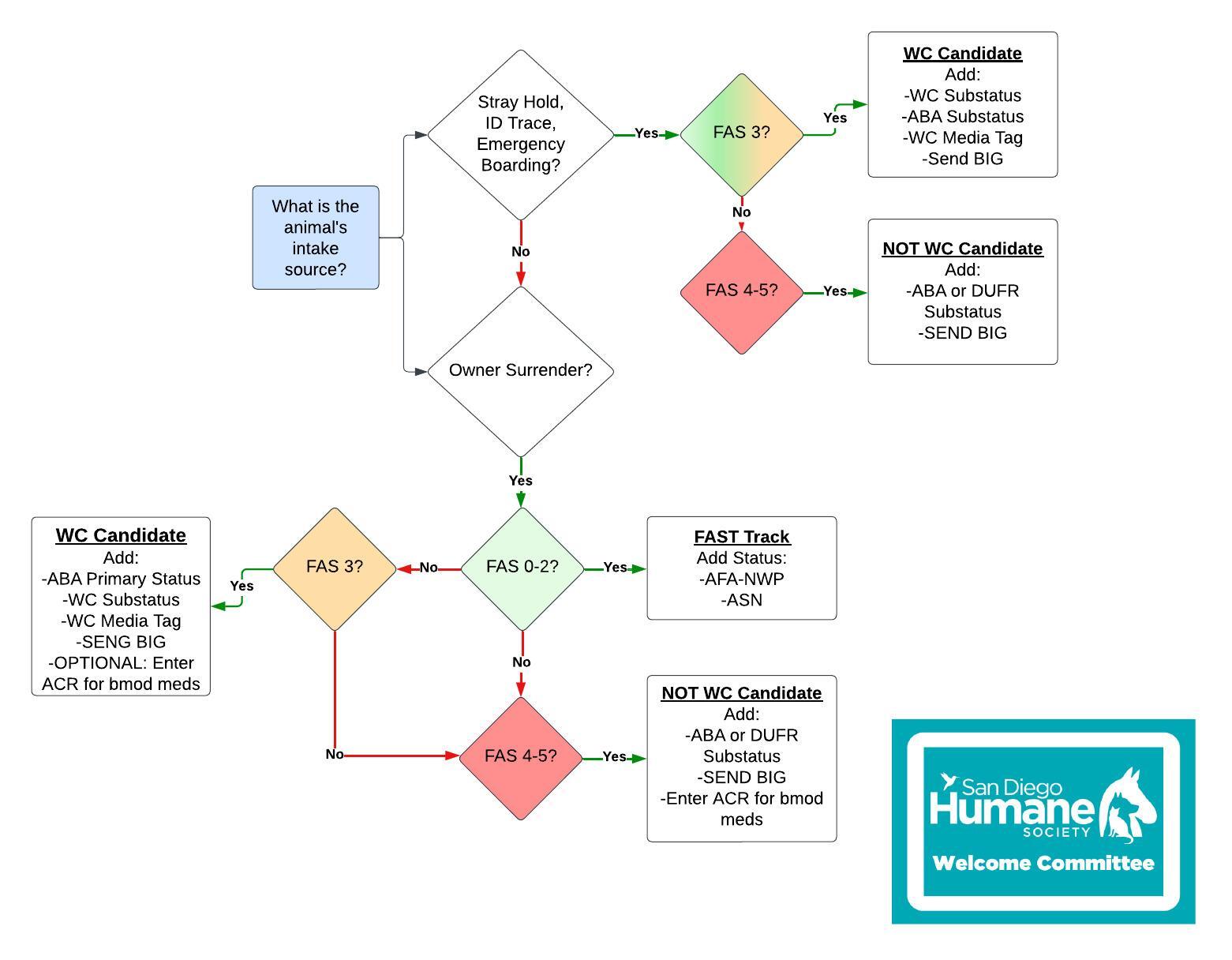
Welcome Committee candidates include dogs who will be placed in a Stray Hold, Emergency Boarding or ID Trace status or are returned or owner surrendered and will be placed in an Awaiting Behavioral Assessment status in our shelter database (ShelterBuddy) and display FAS scores of 3 during their first 24 hours in the shelter.
Generally, the Admissions team or Animal Services Leadership will identify candidates for WC at or shortly after the time of intake. Animal Services Leadership will also review records for WC dogs and determine if further assessment with the Behavior & Training team is needed before they are moved along an adoption pathway into their next status.
Welcome Committee Candidate Identification:
Dogs enrolled into the Welcome Committee will be identified via the use of statuses and tags in ShelterBuddy, kennel front indications and whiteboards in kennel areas.
Stray Hold, ID Trace and Emergency Boarding Status:
For Welcome Committee candidates in Stray Hold, ID Trace, or Emergency Boarding statuses, enrollment in the WC will continue for as long as they are in this status. Animal Services leadership will assess behavioral progress via reviewing notes in records for dogs who are moving out of these statuses and either update their status to Awaiting Behavioral Assessment to prompt further evaluation with the Behavior & Training team or move these dogs along an adoption pathway.
Owner Surrender/Returned Status:
Dogs who are surrendered by their previous owners or are returned after adoption are also candidates for the WC and should be placed in an Awaiting Behavioral Assessment status with a Welcome Committee sub-status. A BIG should be sent if the dog has an FAS score 3 or above. When in an Awaiting Behavioral Assessment status, the Behavior & Training team will review information in records and either move the animal along an adoption pathway or evaluate further on days 2 or 3.
Tracking Welcome Committee Dogs:
Tracking Welcome Committee via sub-statuses and media tags that correspond to the appropriate campus is an essential part of the WC program. Tracking WC dogs in our shelter database, ShelterBuddy, allows us to evaluate the impact of this program on WC dogs and shelter operations (LoS, outcomes, etc.).
Admissions Team Responsibilities:
Admissions Counselors will identify WC candidates by evaluating the FAS scores of all incoming dogs who will be placed in eligible statuses. Dogs with an FAS of 3 should be enrolled into WC, and Admissions Counselors should take the following actions.
FAS score of 3 is identified:
-
Appropriate status is checked (Stray Hold, ID Trace, Emergency Boarding)
-
Note FAS score along with an objective description of behavior in GANs
-
Add a sub-status of Welcome Committee and ABA

-
Place a Welcome Committee media tag, for the appropriate campus

-
Send a BIG
-
Enter ACR for behavior medication drugs
-
If the dog is an owner surrender and has an FAS score of 3, the status should be made Awaiting Behavioral Assessment with a Welcome Committee sub-status
-
Update kennel card or whiteboard with Blue Dot to indicate Welcome Committee
FAS score of 4-5 is identified:
Dogs with an FAS score of 4-5 are not candidates for WC. Please refer to the Admissions and Behavior Information Group SOPs to determine appropriate steps.
Animal Services Leadership Responsibilities
-
Pull daily report to identify dogs in care with a Welcome Committee sub-status
-
Ensure steps above have been taken
-
WC dogs meet criteria
-
GAN is placed
-
Sub-statuses and media tags are placed
-
When updating to next status, review and update sub-status (Awaiting Spay/Neuter, Available for Adoption- No Web Presence, Awaiting Behavior Assessment)
-
If in an Awaiting Behavioral Assessment status, the Behavior & Training team will evaluate and update status
-
If dog is moving into FAS scores of 4 or 5, remove from Welcome Committee
-
Place GAN
-
Send BIG
-
Remove sub-status
-
Remove kennel indications and erase from whiteboard
Animal Care (AC) Team Responsibilities:
Review reports, kennel indications and whiteboards, implementing additional enrichment and recording behavior changes via GANs. For AC team members who have completed the WC educational course, implement the use of behavior plans.
Behavior & Training (B&T) Team Responsibilities:
Monitor information shared via GANs, and perform a behavior evaluation as needed for dogs in an Awaiting Behavioral Assessment status to adjust intervention and pathway planning.
Volunteer Engagement Team Responsibilities:
Assist AC team and B&T teams through foundation volunteer support (cutting up treats, calm and quiet, and other approved training plans).
For Dog Team members who have completed the WC educational course and are a part of the WC team, review kennel indications and whiteboards, implementing additional enrichment, behavior plans and recording behavior changes by submitting notes via the WC Google form QR code.
Welcome Committee In Action:
Everyone can support Welcome Committee dogs! The heart and purpose of the WC program is to provide early behavioral support. All staff members and volunteers can participate in supporting WC dogs through ensuring their housing is enriched (see below), providing them additional in-kennel enrichment and by tossing or dropping treats when passing the kennels of WC dogs.
Behavior plans are another core component of the Welcome Committee, however not all staff and volunteers will be equipped with the skills needed to implement the behavior plans effectively. Behavior plans should only be implemented by staff and volunteer participants who have completed the WC educational course and are approved for these advanced activities.
Housing:
Enriched housing has been shown to reduce stress in kenneled dogs by providing them with the opportunity for choice and control over their environment.
In addition to enriched housing, different kennel types and locations can also impact behavior. For WC dogs, and others, careful consideration should be given to how kennel type and environment surrounding the kennel (location) may impact behavior.
Dog kennels should include the following items:
-
Soft bedding
-
Raised beds
-
Water and food bowls
-
Toys that promote species-typical behaviors such as chewing, dissecting, seeking and foraging
-
If needed, a kennel cover provides a visual retreat and a hiding place. Alternatively, airline or covered wire crates can also provide a safe place to hide.


Enrichment:
Enrichment is an essential component to animal husbandry in any setting, and is especially important for animals housed in shelters. Enrichment reduces stress and improves psychological well-being by providing animals with physical and mental stimulation, encouraging species-typical behaviors, and allowing animals more control over their environment (ASV Guidelines).
Enrichment programs and behavior modification go hand-in-hand. When implemented appropriately, enrichment may increase the success of behavior modification efforts.
Enrichment can take many different forms, depending upon the provider, available resources and the individual animal’s preferences and needs. At San Diego Humane Society, enrichment is typically divided into the following general categories:
-
Enhancements to kennels (e.g. areas to perch/scratch for cats, novel toys, raised beds)
-
Sensory enrichment (visual, auditory, olfactory, taste, touch)
-
Social interactions (e.g. play pairs or groups, co-housing, 1:1 time with people)
-
Physical exercise (e.g. walks, toy play)
-
Cognitive enrichment (e.g. clicker training, puzzle toys)
For more information on enrichment, please see the SDHS Enrichment Guidelines and Play pairs and Playgroups SOP in Mindtouch.
Treatment Roadmaps and Behavior Plans:
Behavior plans that employ the use of Desensitization and counterconditioning to Proximity (of people), Handling, Walking Equipment and Containment & Transport are utilized by the WC team. The following Roadmap organizes these Behavior Plans in the sequential order that they should be introduced:

To view these Behavior Plans in full, please refer to the Behavior Bucket in Mindtouch.
Guidelines for Entering Notes:
Welcome Committee participants are responsible for sharing their objective behavioral observations via the ShelterBuddy General Animal Notes (GANs) section (for staff) or through the use of QR codes for a Google form (for volunteers), using the provided Welcome Committee notes template. In ShelterBuddy, this template is located under the Animal Care Observation Notes category and appears like-so:
Training Plan (list the name of the training plan(s) you are working on):
Observations (objective description of your interaction):
Highest FAS score:
Volunteer Observation form submitted for behavior concern (for volunteers): Y/N
Guidelines for Writing Objective Descriptions:
Observations should be described objectively, whether reporting our experiences with an animal, performing an evaluation, or recording information about its history. This helps us to communicate effectively about behavior in a way that does not have multiple interpretations. The value of the information we provide is influenced directly by the words we choose.
|
Objective |
Subjective |
|
|
-
Be observable. Describe the behavior precisely as it was seen or heard. Rather than writing, ‘He wanted to attack the other dog,’ write, ‘When the dog on the other side of the fence came within 3 feet of him, he began lunging and biting the chain links.’
-
Use action words.
-
Avoid ascribing motivations, feelings or reasons for doing things. There is no way to observe a dog’s motivation or feelings. Is a dog playing fetch because he loves it, or for another reason, such as boredom or toy guarding? Rather than saying, ‘He loves playing fetch,’ say, ‘When we arrived at the pen, he picked up a tennis ball in his mouth and ran away from me. I threw another tennis ball. He retrieved it and let the other ball go. I threw the first ball and he retrieved it, letting the second ball go. We did this for the next 20 minutes until it was time to go inside.” See additional examples below.
-
Be specific, not vague. Rather than writing, ‘He is barrier reactive to most people,’ write, ‘He was barked at 3 out of 4 staff members who walked past his kennel today.’
-
Be concise.
-
Be measurable.
-
Record enough detail to relate what happened, but avoid biasing your description.
-
Words should describe but not judge.
-
Record behaviors in the order they occurred.
-
Context is important! Behaviors that appear in the shelter do not always appear in the home (or vice versa). A dog who plays fetch for hours at the shelter may not do this at home.
|
Use this |
Not this |
|
When the dog on the other side of the fence came within 3 feet of him, he began lunging and biting the chain links |
He wanted to attack the other dog |
|
When we arrived at the pen, he picked up a tennis ball in his mouth and ran away from me. I threw another tennis ball. He retrieved it and let the other ball go. I threw the first ball and he retrieved it, letting the second ball go. We did this for the next 20 minutes, until it was time to go inside. |
He loves playing fetch |
|
He was barked at 3 out of 4 staff members who walked past his kennel today |
He is barrier reactive to most people |
|
Dog was at the front of the kennel and appeared loose in body. Licked my hand through the bars. |
Dog was happy |
|
When I approached the kennel the cat was crouched down in the corner and hissed when I approached. |
Cat was angry |
|
When I leashed and walked the dog, she had a low wagging tail and was soliciting me by lifting her paw and nudging my arm with her head. |
The dog was really sweet with me |
|
Dog was in the back of kennel, looking directly at me; his ears were back and his tail was tucked. When I approached him he lifted his lip at me and growled. When I attempted to place a leash around his neck, he suddenly approached me and bit me on my arm. The bite left a red mark but did not break skin. |
Dog nipped me |
For more information on objective note taking, please see the Behavior GANs Protocol and Behavior Language Resources in MindTouch.